I don’t get to ring on long drafts a lot, but I try to incorporate an understanding of long drafts in my handling instruction to help learners understand the motivation behind handling and bell control details. Seven of my learners recently got lots of compliments on their first visit to a long draft – St. Mary’s Warwick, so I think the effort is paying off.
At least three things change as rope drafts get longer, especially if the ceiling height is high without rope-guides:
The rope is more free to wander around. Whatever momentum you impart to the rope will move it further on a long draft than a short one.
There will be more stretch in the rope. This makes it more difficult to feel the bell and pull the right amount at the right time.
There is more rope weight that has to be lifted, requiring more power in the handstroke pull, and increasing the risk of overpulling on the backstroke.
These three elements also interact in ways that make things more difficult. Since the rope is more likely to wander around, it is more important to get a very good followthrough on the backstroke. But, at the same time, it is very important not to overpull the backstroke, as the added rope weight is also adding momentum to the bell. Also, the greater power on the handstroke increases the asymmetry between hand and back, and making it more likely the novice ringers will pull the backstroke more than usual, instead of less. The stretch in the rope often means that the initial pull to get the bell moving must be a bit firmer, but then you must guide the rope through 90% of the stroke with a very light touch, finishing with a firm flip toward the floor at the bottom.
Good followthrough is important because it minimizes how much the rope lifts off the wheel, which in turn minimizes how much the sally jumps and dances when the garter hole passes the pulley. If you have a 15 ft draft, and an imperfect followthrough, perhaps the sally will dance about a few inches. But if you have a 30 ft draft, the sally may suddenly dance about 8 or 12 inches, because the longer draft means larger amplitude waves down the length of the rope.
The rope’s tendency to wander also means that any deviation the hands make from a straight line will be amplified. If the hands move apart (out to the side) just a couple inches during the followthrough, the rope will follow, potentially moving several feet. Even a small “wood chopping” motion may throw the rope several feet out into the middle of the chamber, potentially making it impossible to reach the sally. And if you overpull the backstroke, the bell will then whack the stay, a bit harder than you expect because of the rope weight.
What all this comes down to: If you don’t already have good habits – straight pull, good followthrough, gentle backstroke, firm handstroke – then a long draft will greatly amplify any imperfections, and it is quite difficult to suddenly improve your handling to meet these difficult conditions. So, get feedback and work on improving these things in your home tower!!
In teaching new ringers, we tend to worry most about the handstrokes, because there is so much going on with the hands and timing concerns. We overlook how important the backstrokes are as a foundation for rope control and bell height and speed regulation.
If we spend more time refining the learner’s backstroke skills, they can learn a lot, and be much better prepared when the handstrokes are introduced.
It is helpful to think about the strokes as the entire period of time that there is (or should be) tension in the rope, so I’ll include the rising backstroke following the handstroke pull as part of the backstroke.
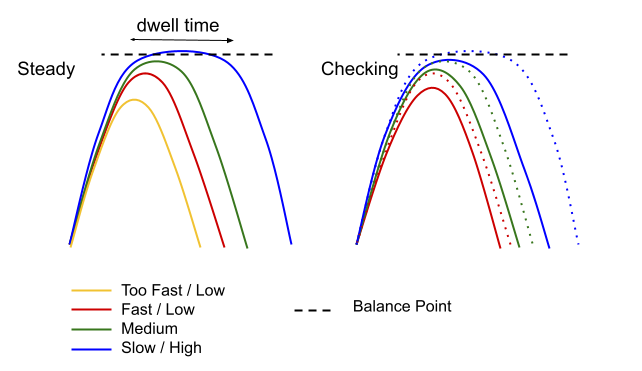
Near the balance, a small change in energy / momentum can make a large change in dwell time. Think of the dwell time as the time from when the hands are three inches below their peak on the way up, and on the way down.
When first learning backstrokes, getting too close to the balance can cause a lot of problems, because the learner hasn’t internalized enough of the subtle feeling and timing to respond reliably to small changes.
Introductory Session
When introducing backstrokes, you want to keep the bell perhaps 4-5 inches below the balance, but with even handstroke and backstroke rhythm. Both handstroke and backstroke trajectory should look like the red curve on the left. If you asked the learner to ring half way up first, this should feel very natural to them – a bit slower than the rhythm for ringing halfway up, but still quite similar. Make sure the learner knows that they are just guiding the rope, not pulling against it on the way up, nor pulling it back down, but just maintaining a couple pounds of tension in it. This is often best demonstrated by showing them how hard they should grip the tailend – very gently, so that the instructor can pull the tailend out of their hands with just gentle tension – perhaps 4-6 lbs or 2-3 kg force.
If the learner has too short a tail end, or is resisting the rising backstroke too much, this will result in checking, and the trajectory will resemble the red curve on the right. This might lead to asymmetric dwell time, and the teacher might have to pull harder than they should. Identify the problem, and ask the learner to let out a little rope, or to let their hands float up and perhaps stretch a little more, so they aren’t dragging the bell down. Again, this goes pretty easily if you did a good job teaching them to ring half way up – checking only in the early phase to make the bell chime, but then letting the hands float up with just a little tension.
If the learner is pulling too hard, you’ll be happy that the bell is 4-5 inches below the balance – it will be easier to absorb the extra energy in the handstroke without bumping the stay. But correct the problem quickly, and get them to just pull very gently.
If the teacher doesn’t pull the handstrokes hard enough, then the bell will drop, getting too fast and low, as in the yellow curve on the left. You may note that the learner is letting the rope go slack. Do not tell the learner that they need to pull harder, or pull earlier, or take in rope. Instead, recognize that you aren’t pulling hard enough, and pull harder. If the handstroke is starting to disappear, help the learner pull the backstroke to get the bell back up, rather than asking them to pull harder. When you get it right, the handstroke dwell time should be about the same as the backstroke dwell time. When you aren’t pulling hard enough or the learner is checking the bell, then you will likely get uneven dwell time, with quick backstrokes, and slower handstrokes.
Backstroke Assist
As mentioned above, you may sometimes need to help the learner pull the backstroke a bit. Don’t grab the rope and pull hard on it. Instead, grip gently with thumb and two fingers just where the learner’s right forefinger lies on the rope, and provide gentle pressure on the learner’s fingers to guide the hands and rope down. You need to move your hand in synchrony with the bell motion, just applying the gentle pressure.
You can also use this gentle finger grip to feel whether the learner is maintaining some tension in the rope. If they are, you will feel a little stiffness in the rope. If they are not, you will feel slackness in the rope. As you practice this (perhaps with a ringing helper) you will get more and more skilled at feeling exactly when and how much tension the learner is providing.
You can also use this gentle grip to help fine tune the rising backstroke, and the followthrough, and to help ensure that the learner adjusts when you do the momentum exercises described below.
Followthrough
When you both are pulling the right amount, with the teacher doing 80-90% of the work, and the learner always has gentle tension above chest height, it is a good time to ensure that the pull is straight, and the followthrough is thorough, with a nice flick at the bottom. This should have been developed pretty well while working on ringing the bell halfway up and down again. The rope should stay well behaved, without snaking about. If the rope snakes at all, it indicates that the learner isn’t maintaining tension through the followthrough. The rope also should not bulge or curve out at belly level, but should stay straight and only bend at the learner’s fingers, until the hands are all the way down.
Get used to looking both up and down (but letting the learner know you are doing this in order to teach, and that they should look past you and to one side, not up or down). You want to get used to seeing whether there is tension in the rope overhead, too much tension and checking, good timing on the downward movement, and good followthrough at the bottom. These will likely all degrade a bit when you or the learner change the conditions, or you introduce something new, and you want to learn to detect those changes.
Seeing and hearing the “dwell time”
As you work on teaching, you want to develop a subconscious sense of whether the backstroke dwell time is what you expect. When ringing 4-5 inches below the balance, it will be a bit short, but if the learner takes in rope, or starts checking the bell, you want to be able to detect that change. You will get used to seeing and hearing this – either a bit too abrupt change in direction of the learner’s hands overhead, or a little bit asymmetric handstroke and backstroke interval.
Part of the import of this is to ensure that you are pulling the handstroke the right amount. If you don’t pull hard enough, one of two things will happen:
The bell will drop, and ring faster and faster. You want to detect this within one or two whole pulls.
The learner will have to overpull the backstroke to compensate (as you taught them to do with the momentum exercises) and the handstroke/backstroke interval will become asymmetric – with quick backstrokes and slower handstrokes.
Why is this important? If the bell drops, things will go faster and faster, the handstroke will disappear, and you will have to take over or help with the backstroke. This makes the learner feel anxious, lose confidence, or worry that they are doing something wrong. Also, it indicates that they are not learning the appropriate reaction that will be needed later to regulate the bell height.
If the learner pulls the backstroke harder to compensate (as they should), they will get in the habit of overpulling the backstroke. This will cause a wide range of problems later when they start ringing both strokes, and work on ringing in rounds or trying to set the bell. Overpulling the backstroke gets harder and harder to unlearn the more they get to practice it.
Next: Momentum changes
It is best if the learner begins very early to understand how to regulate the bell height, and start developing the muscle memory to do automatically.
Ask the learner – “What happens if I pull harder”. Talk about the momentum that the bell carries as it turns around. If you add more momentum on the handstroke, they will feel that momentum carried through to the rising backstroke. What is their natural reaction likely to be? Ask them! If they think about it, they might realize that they should not pull harder, too, but that is the natural reflex.
Now try doing it a few times – gently – warning them first – just enough to make the bell rise an extra 3-4 inches. The learner should feel the extra momentum, resist over the last 2-3 inches, and then pull very gently so they don’t add any additional momentum. The trajectory should look like the green curve on the right – very similar to the red dotted curve (identical to the red curve on the left), but subtly different, because the bell rises with a bit more momentum, and the learner has to slow the bell so that it doesn’t go much higher than before.
What will happen if you don’t pull the handstroke at all? How will the learner likely respond? They may wait to feel the usual tug overhead, and even if they maintain tension, they will likely pull even less than they usually do, as the bell falls earlier, as in the yellow curve on the left.
In order to be able to regulate the height of the bell, the learner needs to learn that when they feel extra momentum at the top of the backstroke, they must resist it, and then pull very gently. And, when they feel slackness at the top of the backstroke, they must pull early and firmly, to restore the desired momentum to the bell, so that the bell doesn’t drop. Ideally, the work should be done on the handstroke, but when the handstroke pull is insufficient, they should pull the backstroke just a little harder.
Discuss this, and then practice, warning the learner that you are going to pull the handstroke less. Keep a hand up and be ready to help them pull at the right time, in case they don’t adapt to the quicker rope fall.
Modeling good handstroke hygiene
As you are ringing the handstrokes, you are modeling what the learner will have to do a few lessons in the future. If you model it well, they will subconsciously learn from the modeling.
If you model hands down near your pockets, and hands coming up while their hands are still going down, they will subconsciously tend to learn to abort their followthrough, move their hands out to the sides, bring their hands up too early, and grab at the sally instead of matching it’s upward motion.
This may sound overly pedantic, but if you observe people who have recently learned to ring in such circumstances (or even some people who have been ringing for several years), you can see the handling quirks that result and how they interfere with good handling later. It is tempting to blame the learner for not following later instructions, but the teacher(s) share in the fault, for inadvertently providing poor role modeling in early sessions.

 The Bell Whisperer